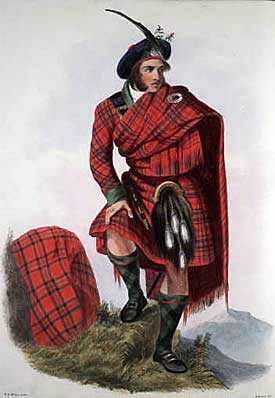
 What is it that makes the Scots Scottish? And if you think of Scotland or its inhabitants what is the first thing that springs to mind? The history and the clans perhaps? The beautiful landscape? The castles? The bagpipes? The Highland Games? Or is it whisky? Fact is that you are likely to find some unique features in Scotland and its people that you won’t find easily, and originally, anywhere else in the world. For most outsiders Scotland is about clans, battles, kilts, tartan etc. It must be said though that this image is up to a certain point valid for the Highland-Gaelic area but doesn’t include the lowlands of Scotland although most people, and specially the tourist agents, want us to belief that. But let’s start with the typical images some of us have and deal with the other things that make the Scots Scottish later.
Highland Clans
Many years ago the ruggedness of the land led to the separation of the Highlanders into small groups called clans. Each clan was ruled by a chief, and the members of a clan claimed descent from a common ancestor. The traditional garment of the Highland clansmen is the kilt (belted plaid), which is suitable for climbing the rough hills. Each clan had its own colourful pattern for weaving cloth and these patterns are called a tartan. Nowadays the kilt is no longer a historic dress but a national costume, proudly worn for special occasions such as weddings etc. I have heard that there are currently over 4,500 different tartans and you can even have your own tartan if you like. Visit one of the many Woollen Mills you’ll find all over Scotland for some tartan related products. The most renowned one is probably the Edinburgh Woollen Mill at the beginning of the Royal Mile.
The clans aren’t something from the past, they are still here today. Currently there are more than 500 active clans registered all over the world and they all play an important role in maintaining and celebrating the Scottish traditions. There are annually more than 100 gatherings of the clans, which draw many visitors to the Highlands.
Gaelic Language
At the last census of 2011 there were almost 60,000 Gaelic speakers in Scotland, mostly confined to the Gaelic Heartland, the Outer Hebrides, and the other Hebridean Islands and the north-west coast. Although the language is in decline, there are many efforts to keep the Gaelic language and culture alive. Many schools in the west of Scotland either have a Gaelic unit or teach Gaelic as a second language. The Royal National Mòd is a celebration of the Gaelic language and culture and is held annually in the west and north of Scotland.
Highland Games
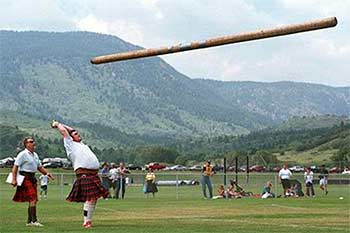 Despite their name, Highland Games are held all over Scotland, From Spring To late Autumn: they vary in size and differ in the range of events they offer, and although the most famous are at Oban, Cowal and especially Braemar, often the smaller ones are more fun.
The Highland Games probably originated in the fourteenth century as a means of recruiting the best fighting men for the clan chiefs, and were popularised by Queen Victoria to encourage the traditional dress, music, games and dance of the highlands, various royals still attend the games at Braemar.
The most distinctive events are know as the heavies tossing the caber, putting the stone, and tossing the weight over the bar, all of which require prodigious strength and skill. Tossing the caber is the most spectacular and the most well known event in the highland games, when the athlete must run carrying an entire tree trunk and attempt to heave is end over end in a perfect, elegant throw.
Just as important as the sporting events are the piping competitions for individuals and bands and dancing competitions where you will see young children tripping the quick, intricate steps of such traditional dances as the Highland fling.
When on holiday in Scotland the Highland games should not be missed and will give you a great insight of Scottish traditions, and leave you with many memories of a great day.
Highland Dress
At formal occasions the Scots proudly wear their Highland Dress which consists of a kilt and other pieces of clothing depending on the occasion. The Scottish kilt is usually worn with kilt hose (woollen socks), turned down at the knee, often with garter flashes, and a sporran (a type of pouch), which hangs around the waist from a chain or leather strap. This may be plain or embossed leather, or decorated with sealskin, fur, or polished metal plating. Other accessories which are often used are a belt with embossed buckle, Argyll jacket, a kilt pin and a black knife worn in the top of the right hose.
Bagpipes
Scotland is often associated with bagpipes but the interesting fact is that bagpipes aren’t originally from Scotland. Bagpipes originate from southern Europe and appear in Scotland around 1400 AD. The Scottish Bagpipe, or Great Highland Bagpipe, became established in the British military and achieved the widespread prominence it enjoys today, whereas other bagpipe traditions throughout Europe, ranging from Spain to Russia, almost universally went into decline by the late 19th and early 20th centuries. Though widely famous for its role in military and civilian pipe bands, the Great Highland Bagpipe is also used for a solo virtuosic style called pibroch. If you’re interested you can visit the annual Glasgow International Piping Festival which is held in August.
Now that I have written about the image most tourists have of Scotland it’s time to realise that Scots are also just people like you and me and are not running around over the hills in kilts all day. They are a usually very friendly bunch and are fortunate to live in a beautiful country of which they are very proud of, and for a good reason I might add. The rich history, the unpredictable climate and the dramatic landscape plays an important part in daily life, specially if you consider that many Scots earn their living in the tourism industry.
Food and Drink
 Haggis is Scotland’s national dish, although a good curry comes in second and for some even in the first place. Haggis is a dish containing sheep’s ‘pluck’ (heart, liver and lungs), minced with onion, oatmeal, suet, spices, and salt, mixed with stock, and traditionally simmered in the animal’s stomach for approximately three hours. If it’s prepared properly it’s a real treat! Haggis is traditionally served with the Burns supper at January 25th or thereabouts, when Scotland’s national poet, Robert Burns, is commemorated. He wrote the poem Address to a Haggis, which starts “Fair fa’ your honest, sonsie face, Great chieftain o’ the puddin-race!” and is usually proceeded by a piper.
Apart from the Haggis, Scotland has many other delicious dishes on offer and one of the most bizarre things you can buy in some Scottish fish and chip shops are, besides fish and chips of course, deep fried mars bars. Whether this is a treat or not I’m not sure, fact is that they are not good for your health but seem to taste surprisingly well! If you want to try something different go for an Arbroath Smokie, a specially smoked type of Haddock and the name is protected by EU regulations. Arbroath Smokies originate in Auchmithie, a small fishing village a few miles north of Arbroath, on the Scottish east coast. If you think whisky is the only national drink you’re wrong. There is also Irn-Bru, a carbonated fruit flavoured soft drink, which also carries the title of Scottish National Drink, or perhaps better the “other” national drink. Another typical Scottish thing is Shortbread, a buttery biscuit, available almost anywhere and specially in the tourist shops! Read more in our Scottish Food Guide.
Ceilidh
If you are staying in Scotland you are likely to hear about a ceilidh, specially if you stay in the more traditional Highland hotels or smaller villages. A ceilidh is a traditional Gaelic social gathering, usually held in village halls and hotels, and involves playing folk music and dancing and this is very much the case today. In the old days it was literary entertainment where stories and tales were rehearsed and recited, and songs were sung. A ceilidh can be good fun and entertaining and you can also work on your traditional Scottish dances which come in many forms and paces to suite both the young and the old. Attending one is a must when you are holidaying in Scotland.
Religion
After you’ve spent the Friday or Saturday evening partying at a ceilidh or visited one of the many pleasant pubs and bars you are likely to find out on Sunday that religion plays an important part in Scotland. The Scottish Presbyterians is the official, as well as the largest, church in the country. The Church of Scotland, as it is called, claims the adherence of nearly half the population. Roman Catholics, particularly strong in the western Highlands, make up the second-largest group of worshippers. After the church visit on Sunday morning you’ll find out something that isn’t at all common in other European countries, the Sunday Paper. Don’t be surprised when visiting a local shop in the Highlands that around two o’clock it suddenly becomes very crowded. The reason for that is the arrival of the Sunday Paper, bought by many and often accompanied with a (wee) bottle of the national drink! While most of the readers go back home, others regard this as an opportunity to visit the local pub and meet their friends.
Sports
 For many (overseas) tourists Scotland is renowned for being the “Home of Golf” and many visitors are very keen to play the famous links at St. Andrews in Fife. For the Scots themselves soccer is the national passion and beating England the most important goal, and this is not only in soccer… Also famous in soccer is “The Old Firm”, a common collective name for Celtic and Rangers, both football clubs from Glasgow. Whereas Celtic’s fans are mostly catholic, the Rangers fans are mostly protestant. The competition between the two clubs is fierce and often leads to violence between rivalling supporters, not only on match day. Both teams usually meet four times a year in the Scottish Premier League. Other popular sports include hill-walking, rugby, shinty, lawn-bowling, fishing, darts and curling. The island of Ailsa Craig, off the Ayrshire coast, provides the special granite for most of the curling stones.
It’s hard to write everything down that’s related to Scottish Culture, otherwise it would become an endless page. You will find that much of the Scottish culture and traditions are saved in the many festivals that are held annually, all over the country and all year round and perhaps especially during Hogmanay. The best thing to do is go out there, spend some time in one place, visit the pubs and ceilidhs, experience some of the festivals and other events and try to get to know the locals a bit better. That’s how you discover for yourself what the Scots and their culture are all about and you will be pleasantly surprised.
Recent Comments