The Isle of Jura: 200 people, 6,000 deer and one Whisky distillery.
The name Jura is believed to come from the Norse meaning ‘Deer Island’. Early writers speak of a few herds of deer numbering about 300, but the present day population is about 5,500. While it is almost 100% likely that a visit to the island will result in many of these majestic animals being seen, there are many other reasons for a visit. Another attraction the island offers is isolation and an almost unusual silence and peace. Despite its size, around thirty miles long and at most nine miles wide, Jura is sparsely populated, as stated above, and most of the island can only be visited on foot. The west coast of Jura is uninhabited and difficult of access but offer some of the finest raised beaches in the world.
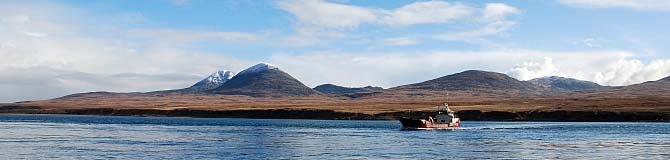
Isle of Jura and Paps of Jura seen from Islay
See and Do on Jura
Jura is ideal for walking and the visitor has almost unlimited freedom to walk almost everywhere and climb the Paps of Jura, visit the Wild west coast with it’s amazing wildlife or visit the Corryvreckan Whirlpool in the north. These are all tough hard walks. If you wish to walk during the stalking season, please check with the gamekeepers concerned. The main stalking season is from August to the end of October.
Paps of Jura
Dominating the view of Jura from almost any direction are the three, distinctive and easily recognised, Paps of Jura found in the southern half of the island. The highest of the three is Beinn an Oir, the Mountain of Gold, is 785m/2576 ft is the only Corbett, a mountain in Scotland between 2500 and 3000 ft. Beinn Shiantaidh, the Sacred Mountain, is 757m/2477 ft and stands to the east of Beinn an Oir, while Beinn a’ Chaolais, the Mountain of the Sound, stands to the south-west and is the smallest of the three at 734m/2407 ft. Cora Bheinn, the steep mountain, stands at a height of 569 m/1893 ft to the north-east of Beinn Shiantaidh and, while not considered to be one of the Paps, is part of the same group of mountains. On one of the Paps remains of a checkpoint from the second world war can be found.
There is a commanding view to be obtained from the top of the Paps on a clear day and it is well worth the effort of climbing one of them, if the weather is settled. To the north can be seen Loch Tarbert, the northern half of Jura, the Garvellachs and Mull. to the Northwest is Colonsay, to the east, the whole of Kintyre with Arran beyond, Ben Lomond and the Cobbler. To the south the Isle of Islay and Northern Ireland.
How to get to Jura
To get to Jura, the majority of people will require a visit to the neighbouring Isle of Islay, separated from the smaller island by the half mile wide stretch of water known as the Sound of Islay, famous for its strong currents. The ferry between the two islands runs from Port Askaig, on the east coast of Islay, to Feolin, in the south-west corner of Jura. From Port Askaig the Jura ferries runs at approx 30min intervals daily from 7.30am till 6.30pm. Booking is not required, a stop at the local petrol station however is recommended if travelling by car. The costs are around £15 return for car and passengers. From Feolin, the single-track road, the A846, heads round the southern end of the island and then along the eastern side giving most visitors access to as much of the island as is possible by car.
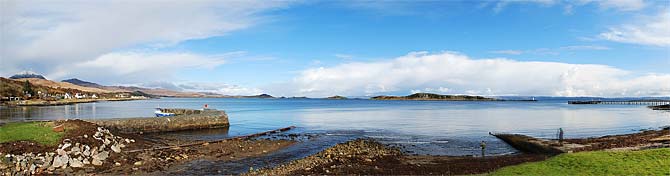
Small Isles Bay seen from Craighouse
Jura House
Jura House, which is located at the southern end of the island, was built around 1880 by the Campbell’s of Jura. The House itself can not be visited and is actually only visible from the ferry between Kennacraig and Port Askaig on Islay. The walled garden was created in the early part of the 19th century and acted as a kitchen garden to the house. The garden is unfortunately not open to the public since 2010. There are a couple of small islands situated off the southern coast of Jura, Am Fraoch Eilean to the south-west of Jura House and Brosdale Island to the south-east. On the first of these are the remains of Claig Castle, one of the sea fortresses that were used by by the Lords of the Isles to control traffic in the seas around the Hebridean islands.
From Jura House, the road heads north-west towards Craighouse, the only village on Jura, and located seven miles from the Feolin ferry. Here there is the only hotel on Jura, the island’s only distillery, the village shop and post office, the gift shop/tearoom and the school. The Distillery and shop are open for visits by appointment only and the tour is interesting and normally not too crowded. The village sits overlooking a bay with a group of islands that are known collectively as the Small Isles. Beyond these islands, Knapdale on the mainland is separated from Jura by the stretch of water known as the Sound of Jura.
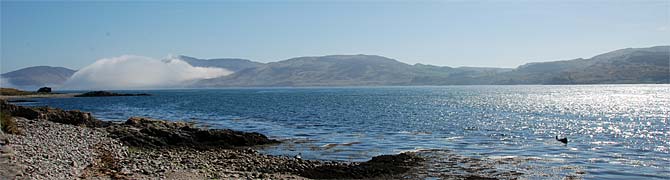
Sound of Islay
Jura Parish Church
Jura Parish Church can also be found in Craighouse and was built in 1777. A room to the rear of the building contains an exhibition of photographs dating back to the early 20th century. There is no charge to view the photographs or enter the church, but donations are welcome. Opposite the church is a lovely sheltered and very quiet beach again offering wonderful views towards the Kintyre Peninsula.
Crofting Communities of Knockrome and Ardfernal
To the north of Small Isles Bay, immediately after the main road has crossed the Corran River, a turning to the right leads to Knockrome and Ardfernal. The river runs into Loch na Mile to the south while Ardfernal overlooks Lowlandman’s Bay to the north-east, which is almost completely closed off by the rocky promontory known as Rubh’an Leim.
The Road north
Back on the main road and heading north once more, Beinn Shiantaidh rises up to the west giving as close a view as possible of one of the Paps without having to leave the road. Lagg, which used to be a ferry port for Knapdale especially during the period when cattle droving was common, is closely followed by Tarbert. At this point Jura is almost cut in two by Loch Tarbert that slices into the western side of the island, with Tarbert in the east only being a mile from the tip of the loch itself. Just beyond the standing stone on the right of the road, a little track leads to Loch Tarbert. This is a short walk of around 20 minutes and takes the visitor to the “other side” of Jura. The main road continues north, but not for much further.
Ardlussa
Near Ardlussa, just after crossing the Lussa River, the road, which has now narrowed even more than it already was, splits, with the southern branch heading towards Inverlussa where the river enters the bay of the same name. Meanwhile the other branch continues north-east almost reaching that end of the island, although by the time it reaches its final destination it can barely be described as a road. From here it is a private road and is closed to vehicles. If you wish to proceed you have to leave the car at “road end” and continue on foot for a further five miles to Barnhill and Kinundrach, almost at the northern tip.
Barnhill
Here in the north of Jura, in Barnhill, the cottage where Eric Blair, who is better known as George Orwell, lived from 1946-48 while writing his novel 1984. Orwell had first visited the island in 1945 and had an almost fatal encounter in the Gulf of Corryvreckan that separates Jura from the smaller island of Scarba to the north. One day in 1947, Blair had taken a break from writing to sail with his nephews and nieces. However, their boat was caught by the whirlpool that the gulf is famous for and, despite losing the boat, Blair and the youngsters managed to reach a small rock where they were later picked up by a fishing boat. Blair returned to Barnhill where he finished his novel, although had things turned out differently on that day in the gulf the world might not have read about Big Brother. The Corryvreckan Whirlpool as it is called is caused by an underwater mountain reaching almost to the surface of the strait causing the whirlpool to activate when the tides change. Especially with a strong westerly wind and upcoming tide the whirlpool is best visible. Jura Hotel runs Landrover trips from Craighouse to Kinuachdrach.
The story of Corryvreckan
The story of Corryvreckan is that of a Scandinavian Prince, named Breackan, who fell in love with a princess of the isles. Her father consented to the marriage on the condition that Breackan showed his courage by anchoring his boat in the whirlpool for three days and three nights. Breackan accepted the challenge and returned to Norway where he had three cables made: one of hemp, one of wool and of of maidens hair. The maidens of Norway willingly cut off their long hair to make the rope for their prince. It was believed that their purity and innocence would give the rope strength to stand the strain. Breackan returned to the Isle of Jura and anchored in the Corryvreckan whirlpool. On the first day the rope of hemp broke; on the second day the woollen rope parted; on the third day all went well until the evening when the rope of hair finally gave way because one of the maidens who had given her hair had been unfaithful. The boat was sucked under by the currents and Breackan’s body was dragged ashore by his faithful dog and carried to a cave – Breackan’s Cave – where he was buried. Amidst myth and legend there is usually a fragment of truth. When the cave was excavated some years ago, a stone coffin was found. Was it the coffin of some prince drowned in the Corryvreckan Whirlpool? No one knows.
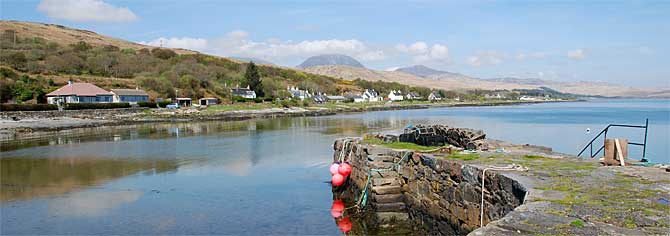
Craighouse on Jura and Stone Pier
Historical sites
Jura has 8 sites of standing stones, the tallest of these being that at Camus-an-Staca. This can be seen as you travel along the road from the ferry about 1 1/2 miles from Ardfin. Look towards Macarthur’s Head on Islay, it’s only 150 yards from the road. Kilearnadil, located in an attractive valley near Keills, is probably the oldest burial ground and contains some interesting gravestones. Here is buried Gillour McCraine who is reputed to have “kept 180 christmases in his own home and died in the reign of Charles 1”. The graveyard at Inverlussa is also worth a visit. Here Mary McCraine, who died at the age of 128 is also buried. There are a number of iron age forts to be found on Jura, and the most spectacular is the one at An Dunan on Lowlandsman’s Bay. Here are, what is believed, the remains of a Viking dry-dock.
More Relevant Information:
- The Isle of Jura on www.isleofjura.scot
- More Scottish island images
Recent Comments